What we're reading · Jewish History
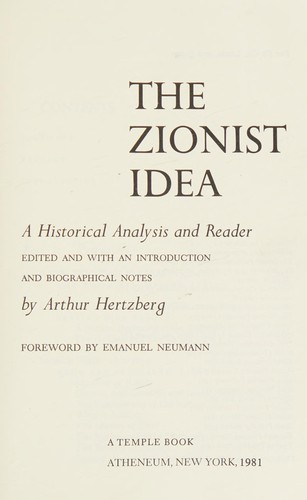
The Zionist Idea
by Arthur Hertzberg (ed.)
Reading together now · Chapter 3 · Moses Hess (1812–1875)
The book in brief
The classic anthology (1959) of the thinkers who shaped Zionism, from the rabbis who called for the return to Zion to Herzl, Ahad Ha'am, Rav Kook and Berl Katznelson. Hertzberg gives each thinker a short introduction, and opens with a long essay on what was new in Zionism and what continued the old.
Chapters
Part One: The Precursors
Three thinkers who wrote decades before Herzl. Two were rabbis, one Sephardic and one Ashkenazi, and the third a socialist who came back to his people.
1Rabbi Yehuda Alkalai (1798–1878)
A Sephardic rabbi, born in Sarajevo, who served as rabbi in Zemun near Belgrade. After the Damascus blood libel (1840) he saw that Jews were not safe in exile, and wrote that redemption would not come by miracle alone: it begins with human action.
The main idea: he read the word teshuvah, repentance, also in its plain sense of return: the return to Zion. Before the full redemption, Jews must go up to the Land, buy land there and build it.
What he proposed: a tithe for settling the Land, an assembly of the elders of the people to lead the effort, and a shared Hebrew language to unite Jews from many countries.
Why it matters to us: one of the fathers of the Zionist idea was a Sephardic rabbi who wrote from within the Torah and the Kabbalah. At the end of his life he moved to Jerusalem himself, and died there.
2Rabbi Zvi Hirsch Kalischer (1795–1874)
Rabbi of Thorn in Prussia and a first-rank Torah scholar. In his book Derishat Zion, Seeking Zion (1862), he argued that redemption comes in a natural way, step by step, not all at once.
The main idea: the beginning is in our hands: to go up, work the land and keep the commandments tied to the Land. Other peoples in Europe are fighting for their lands, and we must do the same for the land of our fathers.
What he proposed: a society to settle the Land, farms, an agricultural school, and self-defence for the settlements. He asked men of means, such as Rothschild and Montefiore, to help.
Why it matters to us: Kalischer showed that settling the Land in practice does not contradict faith in redemption; it is part of it. His ideas encouraged the founding of the Mikveh Israel agricultural school (1870).
3Moses Hess (1812–1875)Reading together now
A German socialist thinker who, as a young man, worked alongside Marx and Engels and drifted away from Judaism. In Rome and Jerusalem (1862), written as a series of letters, he comes back to his people.
The main idea: the Jews are a nation, not only a religion. Hatred of Jews in Germany does not disappear when a Jew assimilates or converts, because it is aimed at his origins. So assimilation solves nothing.
What he proposed: a Jewish state in the Land of Israel, built on social justice rooted in the Torah of Moses. Just as Italy was uniting and Rome was rising again, Jerusalem's turn had come.
Why it matters to us: in his own time the book was hardly read. Forty years later Herzl read it, and wrote in his diary that everything he had tried to say was already there.
Read Rome and Jerusalem in full, free on the Internet Archive
Talk about the book
Follow this book
What did this book stir in you? A question, a thought, something you read differently. Everyone is welcome, whether you have not started yet or already finished.
No thoughts yet. You can be the first.